


Dentures That Look and Feel Real in La Crescenta

Dentures are removable replacements for missing teeth. Complete dentures replace a full arch, while partial dentures fill gaps when some natural teeth remain. For people seeking dentures in Tujunga, including those from the nearby La Crescenta service area, the fit, tooth shape, and shade all contribute to a natural appearance and comfortable feel. A dentist can adjust the fit when needed.
It’s natural to want dentures that feel secure and look like they belong with your smile. Custom design helps tailor the restoration to your mouth and appearance, though removable dentures can have limitations and may need follow-up adjustments. Learn how complete and partial dentures are planned, how impressions help shape the fit, what to expect during fabrication and adjustment, and how their everyday benefits compare with their limitations.
Table of Contents
Dentures’ natural appearance and comfort
Dentures can restore the appearance of a smile and support everyday speaking and eating. Their appearance and comfort depend on how the removable appliance fits, follows the gumline, and suits your facial features.
Natural-Looking Fit and Comfort
A natural-looking result involves more than choosing a tooth color. Tooth size and shape, the visible gum-colored base, and how the denture sits together all influence the final appearance. During fitting, the dentist assesses how the denture rests and how the bite comes together. A loose or painful fit can affect speaking and eating, so ongoing discomfort should be addressed rather than accepted as an unavoidable part of wearing dentures.
Most dental insurance plans cover 50% of denture costs as a major procedure. Medi-Cal is California’s Medicaid program, and Medicaid denture coverage varies by state; the applicable benefit depends on California’s current rules and the patient’s eligibility. Plan coverage and out-of-pocket responsibility can differ, so the specific benefit details matter.
For natural-looking, comfortable denture care in La Crescenta, an evaluation considers both appearance and function. The dentist looks at the gumline, bite, speech, and how the appliance fits during ordinary mouth movements. These details guide design choices and help identify areas that may need adjustment during fitting.
Patient Feedback on Fit and Appearance
Patient ratings may offer clues about how denture care addresses fit, comfort, and natural appearance, but an overall score alone says little about those details. Comments about follow-up adjustments, speaking with new dentures, or whether the teeth look proportionate provide more context. Specific feedback about these experiences is more useful than a general compliment.
No single rating shows how every patient will experience denture care. Feedback reflects individual expectations and circumstances. Consider what comments say about fitting and follow-up, then discuss your priorities during a denture evaluation. That conversation connects your goals with the clinical details that shape care.
Free consultations, payment plans, and financing depend on the office’s arrangements; there is no universal offer for La Crescenta denture care. A consultation’s purpose and any payment options should be explained before treatment begins. Insurance coverage and financing eligibility are separate considerations, so each affects the expected out-of-pocket responsibility differently.
Comfort also depends on function. A denture that shifts may make speaking clearly or chewing more difficult, while pressure can create sore spots. If pain continues, an adjustment or reline may improve how the appliance sits. The dentist evaluates the fit and bite to identify what needs attention. A well-planned denture should support daily routines while complementing natural facial features.
Traditional complete dentures
Traditional complete dentures replace all teeth in the upper arch, lower arch, or both. They are removable appliances fitted after natural teeth are gone and the gums have healed. For patients in La Crescenta, timing depends on whether teeth have already been removed or extractions are part of the treatment plan. A dental examination considers oral health, gum condition, and the desired result before the next step.
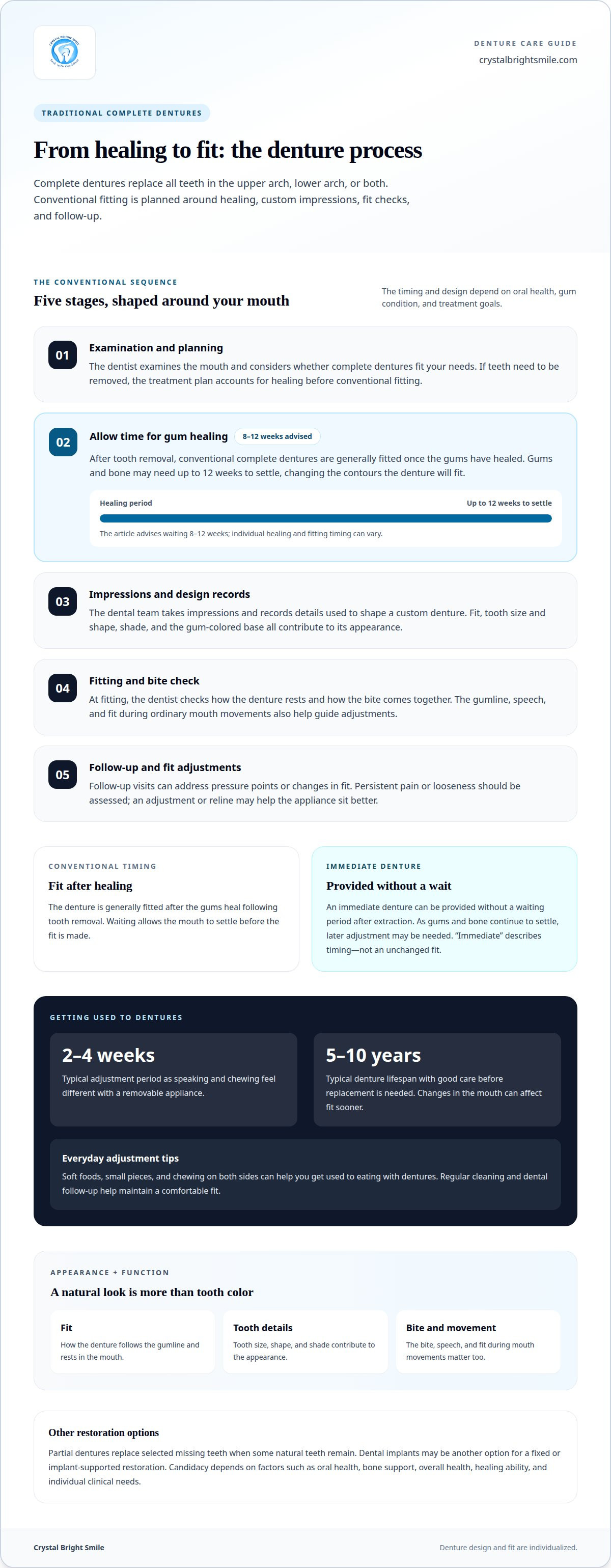
After tooth removal, conventional complete dentures are generally fitted after the gums heal. Patients are advised to wait eight to 12 weeks, and the gums and bone may need up to 12 weeks to settle before fitting. That interval allows the mouth to change after extractions. Fitting too early can mean the denture no longer matches the healing gum contours as closely.
An immediate denture follows a different sequence: it can be provided without a waiting period after extraction. However, gums and bone continue to settle, so the appliance may need adjustment afterward. A dentist discusses timing options during a consultation, considering dental condition, treatment goals, and whether a temporary solution is needed. “Immediate” describes timing, not a promise that the fit will remain unchanged.
Conventional care typically moves through several stages:
The dentist examines the mouth and discusses whether complete dentures suit the patient’s needs.
After any planned tooth removal, the gums heal before conventional fitting.
The dental team takes impressions and records details needed to shape the denture.
The denture is fitted, and the dentist checks how it rests and how the bite meets.
Follow-up visits address pressure points or changes in fit.
New dentures take practice. Patients typically need 2-4 weeks to adjust, as speaking and chewing feel different with a removable appliance. Soft foods, small pieces, and chewing on both sides can help patients get used to eating with dentures. For example, evenly divided bites encourage both sides of the mouth to work rather than placing all pressure on one area.
With good care, dentures typically last 5-10 years before replacement is needed. Changes in the mouth can affect fit over time, so a once-comfortable appliance may need attention sooner. Persistent pain is a reason to have the denture assessed for adjustment or relining. Removable dentures also need regular cleaning and dental follow-up to maintain a comfortable fit.
Complete dentures replace all teeth in an arch, while partial dentures replace selected missing teeth when some natural teeth remain. Dental implants may be another option for patients seeking a fixed or implant-supported restoration. Oral health, bone support, overall health, and healing ability inform candidacy. A consultation compares these approaches with your goals and clinical needs rather than treating one option as right for everyone.
Benefits and limitations of dentures
Dentures replace missing teeth with a removable or supported restoration, but each design involves different trade-offs. The useful comparison is how each option fits the patient’s priorities, oral condition, and treatment preferences.
Implant-Supported and Conventional Comparisons
Conventional dentures rest on the gums and can be removed; implant-supported dentures attach to implants in the jawbone. Implant support may provide greater stability and comfort than a removable option. Appearance also depends on tooth shape, shade, and position, not support alone. Oral health and bone support help shape the comparison.
Conventional dentures do not involve implant placement, while implant-supported dentures involve a surgical treatment sequence and healing. That difference matters when weighing a removable appliance against a restoration anchored in the jaw. Implant candidacy depends partly on oral health, bone support, overall health, and healing ability. Gum disease, medical conditions, and tobacco use may affect healing or timing, so these factors belong in treatment planning.
Support choices are separate from the question of which teeth need replacement. A bridge may replace missing teeth in a particular area, while a denture can address a larger pattern of tooth loss. The dentist considers the location of missing teeth, remaining teeth, and your goals before comparing these options. Cosmetic dentistry can address appearance, but appearance alone does not determine which restoration suits your mouth.
Adjustments, Risks, and Aftercare
A removable denture depends on the contours of the mouth for support. As those contours change, its stability may change too. An implant-supported restoration uses a different support method, but requires an assessment of implant candidacy and healing. Weigh the treatment process and maintenance needs alongside appearance and function, rather than judging a restoration by photographs alone.
If you’re deciding between removable and implant-supported dentures, useful questions include how each option is held in place, what treatment steps it involves, and how it fits your oral health. These questions clarify practical differences without assuming one design is right for everyone. A dental examination connects the options to your specific tooth loss and clinical needs.
Patients considering dentures may also want to distinguish the cosmetic goal from the functional one. A restoration can be planned to suit your smile while addressing spaces left by missing teeth. The dentist considers both priorities, along with remaining teeth and the condition of your mouth, when discussing a denture, bridge, or implant-supported option.
Custom-made dentures
Custom dentures are planned around your mouth, remaining teeth, and smile goals. The dental team personalizes fit, tooth color, shape, and position, then considers how the finished restoration relates to your facial appearance. For example, a patient replacing front teeth may prioritize their smile during conversation, while someone replacing a full arch may also focus on how the denture rests and functions.
Color is one part of a natural-looking result. A dentist considers the appearance of nearby natural teeth, if any remain, and your preferred shade. Shape and size matter too: teeth that look too large or uniform may stand out from the rest of the smile. The goal is a coordinated appearance, not simply the brightest shade. These decisions are discussed during treatment planning.
Fit is tailored to the contours of your mouth. A complete denture replaces a full arch, while partial dentures replace selected missing teeth and work around teeth that remain. A partial denture can use a gum-colored plastic base and a metal framework to help secure it. The dentist considers where teeth are missing and how the restoration will sit alongside existing teeth.
Custom planning connects appearance with everyday function. The dentist evaluates how the upper and lower teeth meet, whether the appliance stays in place, and whether its shape supports speaking and chewing. A denture that looks appealing but rubs the gums may need a fit adjustment. Likewise, a comfortable fit still needs to suit your smile. Both considerations belong in the design discussion.
You can make the planning conversation more useful by describing specific priorities. You might want replacement teeth to blend with the remaining teeth, prefer a less prominent look, or need a partial denture designed around a particular gap. The dentist relates those goals to your oral condition and available design choices. This keeps recommendations grounded in clinical needs rather than appearance alone.
Traditional removable dentures and custom partial dentures address different patterns of tooth loss. A full denture replaces an entire arch, while a partial fills spaces when some natural teeth remain. A dental examination helps determine which design fits your mouth and treatment goals. If your teeth or gums change, the original fit may change too, so the restoration may need professional attention to stay comfortable.
Custom design can restore the appearance of a smile, but it does not make every denture fixed or identical in feel to natural teeth. Removable appliances still require adaptation and care. A thoughtful plan balances facial appearance, gum fit, remaining teeth, and daily activities, giving you clear expectations before fabrication begins.
Denture impressions and fabrication
Denture impressions record the shape of your mouth so the dental team can plan an appliance around its contours. Impressions can help the dental team understand how the jaw functions and moves. These records help connect the denture’s fit with its appearance and everyday function, rather than treating fabrication as a one-size-fits-all process.
The appointment begins with an examination of your mouth and a discussion of the teeth being replaced. A complete denture requires planning for an entire arch, while a partial denture must fit around remaining teeth. The dentist considers gum contours and bite as part of the records used to design the restoration.
Jaw movement matters because the mouth does more than stay still. During the impression process, the dentist assesses how your jaw moves and how the teeth or ridges relate during function. Several impressions can provide information from different positions or movements. This helps the dental team plan a restoration that accounts for your mouth beyond a single resting position.
In broad terms, the process follows a sequence:
The dentist examines the mouth and identifies which teeth the denture will replace.
Impressions record the relevant mouth contours and jaw relationship.
The dental team uses those records to plan the denture’s fit, shape, and tooth arrangement.
The denture is made and assessed in the mouth for fit and function.
Any areas that need refinement are addressed through professional adjustment.
Fabrication turns recorded details into a removable restoration. A complete denture replaces an arch, while a partial design must accommodate your remaining teeth. For instance, a partial denture’s base and supporting framework must align with the spaces being restored. These design choices influence how the appliance sits and how its visible teeth appear in your smile.
Fit and appearance are assessed together. A denture may need adjustment if it presses on the gums, shifts during jaw movement, or feels uneven when you bite. The dentist checks how it rests and functions, then determines whether refinement is appropriate. This assessment is especially relevant when the mouth changes after tooth removal or healing.
Dental implants use a different support approach from conventional removable dentures. An implant is placed in the jawbone and can support a custom crown, bridge, or other implant-supported restoration. Planning for this treatment also depends on an examination of oral health, bone support, overall health, and healing ability.
Clear impressions give the dental team a starting point for a denture tailored to the mouth. Schedule a denture evaluation to discuss fit, design, and the next steps.
Crystal Bright Smile: Dentures and Partials
Crystal Bright Smile provides full and partial dentures for patients seeking to replace missing teeth and restore their smiles. At its Tujunga, California office, the dental team uses digital technology and personalized treatment planning to consider fit, appearance, dental condition, and individual goals. The practice serves patients in La Crescenta, as well as Tujunga, Sunland, Montrose, Shadow Hills, and Lake View Terrace.
A dental examination helps determine whether complete dentures, partial dentures, or another option fits your needs. Dental implants may also be discussed when appropriate, based on your oral health and clinical needs. Recommendations are tailored to each patient rather than assuming one restoration suits everyone.
For a personalized denture evaluation, contact Crystal Bright Smile at (818) 352-8200.
Take the Next Step Toward a Smile That Feels Like You
Your next step is a focused conversation about how you want your smile to look and feel in everyday life. If you’re exploring dentures in Tujunga, discuss your priorities, whether that means a natural appearance, easier speaking, or confidence in your restoration. Crystal Bright Smile is located in Tujunga and may also serve patients from La Crescenta. Those goals help shape a treatment plan around your dental needs.
If your goals involve more than replacing teeth, Crystal Bright Smile also offers dental implants, Invisalign, and porcelain veneers. Which options suit you depends on your examination, oral health, and clinical needs. A personalized discussion can connect your priorities with appropriate care.
Start a conversation with Crystal Bright Smile about your smile goals. A thoughtful next step can make the path forward feel clearer and more comfortable.
Frequently Asked Questions
What Are Dentures?
Dentures are custom dental restorations that replace some or all missing teeth. Beyond filling visible gaps, they can help restore a complete-looking smile and support everyday activities. The term covers different designs, so a treatment discussion should clarify which teeth need replacement and what the restoration is expected to do. The dentist’s recommendation depends on the examination and your priorities.
How much do dentures cost in La Crescenta-Montrose?
There isn’t one denture price that applies to every patient in La Crescenta-Montrose. The total depends on the treatment plan, including the type and extent of restoration, any preparatory care, and whether implant treatment is involved. Insurance benefits and financing eligibility can also affect what a patient pays. The practice provides treatment costs after a quote request, based on the individual case.
What types of dentures look and feel most like natural teeth?
No denture type is automatically the most natural-looking or comfortable for every patient. The number of teeth being replaced, your oral condition, and personal priorities all matter. During planning, discuss which smile details matter most and how you want the restoration to function. The dentist uses your preferences alongside examination findings to recommend a suitable design.
What is the typical cost of full, partial, and implant-supported dentures in La Crescenta?
Full, partial, and implant-supported dentures have different treatment requirements, so costs depend on the individual plan. The extent of tooth replacement, preparatory treatment, and whether implants are included all influence the estimate. A treatment quote reflects case-specific details rather than a standard figure. Insurance coverage and financing eligibility may also affect payment arrangements.
What is the process and timeline for getting custom dentures in La Crescenta?
The schedule varies with the patient’s oral condition and whether tooth removal is needed. For conventional complete dentures after extractions, patients are advised to allow eight to 12 weeks for gum healing; immediate dentures can be provided without that waiting period but may need later adjustment. The dentist outlines the expected appointments and sequence after examining the mouth, since fabrication and follow-up needs differ by case.
How do patients rate denture providers in La Crescenta for fit, comfort, and natural appearance?
Ratings reflect individual expectations and circumstances. Comments about follow-up adjustments, speaking with new dentures, and whether the teeth look proportionate offer more useful clues than an overall score alone.

Comments